
Frequently Asked Questions
Won't it destroy chainsaw chains?
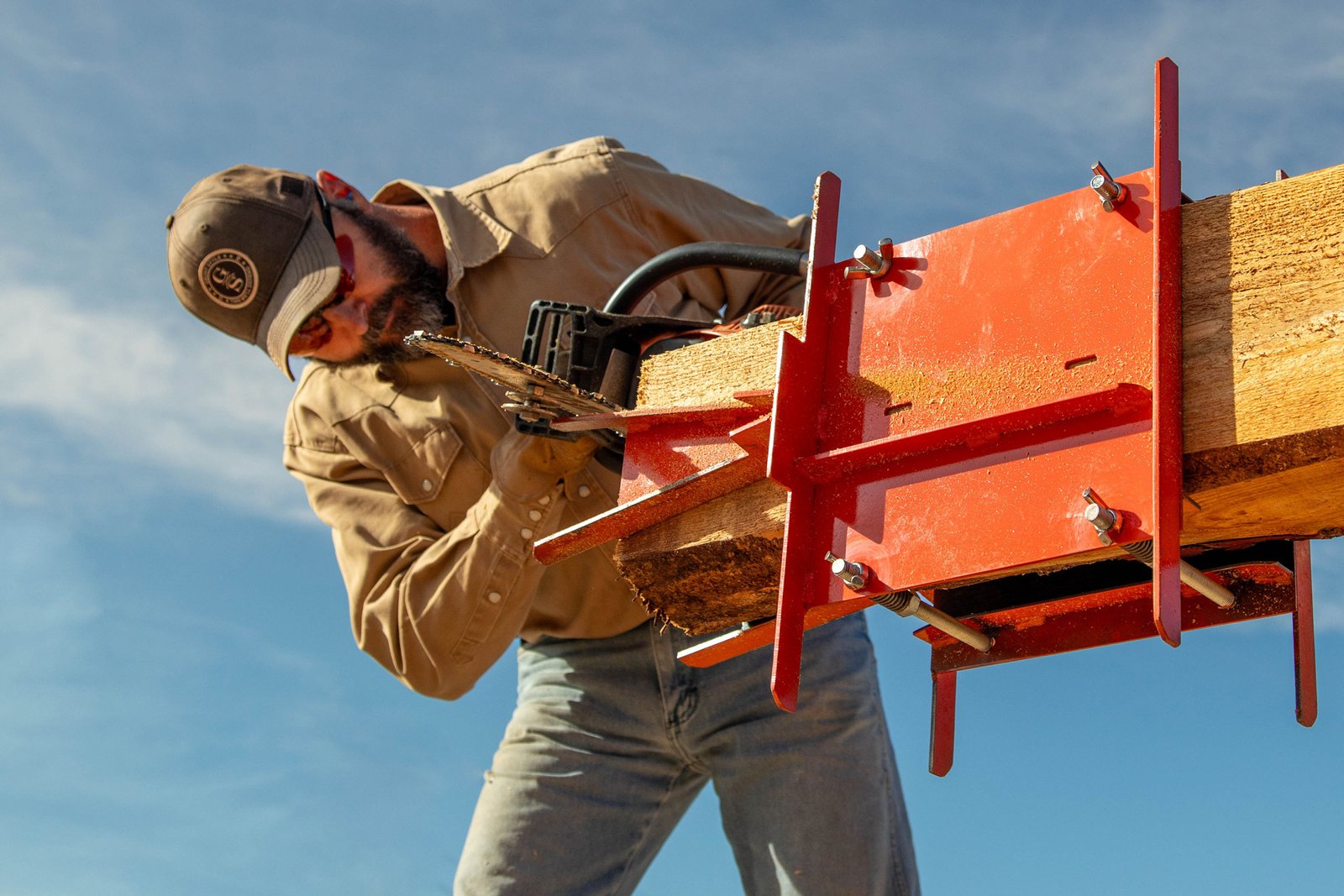
Nope! The jig is designed to work with custom fitted guides on the chainsaw bar that capture the chainsaw on the rails of the jig with precise stops that finish the notch without ever letting the chain come in contact with the metal jig.
Do you offer payment plans or financing?
We do not.
Why are there gaps between your logs?
This unfinished building is called a dry stack. The gaps you see ensure that the weight of the structure is transferred to the corner locking in the joints without hardware and giving margin for the logs to expand and contract with moisture. In a finished building the gaps are filled with chinking. Traditionally, it would’ve been some form of mud or a concrete mix, but those crack and need maintenance. There are companies today that build fantastic synthetic chinking that actually adheres to the log above and below it and maintains enough elasticity to move as the log expands and contracts without cracks or air gaps, sealing an insulative air pocket between the logs.
Can you make it with no chink gap?
Folks tend to either like the look of log siding or think that a zero gap makes it easier because you don’t have to chink it. In reality it makes the build more difficult and doesn’t give you as good of an end product.
The dovetail style of cabin was intended for assembling rough cut, green timber quickly. The nature of logs mean that they expand and contract a little with changing moisture in the air and the chink gap allows for that while guaranteeing that the corner joints will bear the weight of the cabin the whole time, locking them together for structural integrity.
Building without a gap will require more work to get the fit right, which may involve planing the logs to get an accurate fit up and using kiln dried logs. But even then you may end up having to fill gaps that open up down the road as the logs change and those gaps often show up in the corner joint which is not ideal.
All that said, we will make a jig with a zero gap, but only if you understand what it entails. We want you to be happy with your build.
Why does it cost so much?
All our jigs are hand-made in America here in our shop and will not be cheapened. The time and expertise that goes into designing and building them will save so much time and hassle on the construction end of things that it is well worth the investment, even if you only build one cabin. But it gets even better. As long as it’s not abused or left out to rust, the jig is a tool to pass onto your kids and grandkids when they get ready to build their home.
When you start building, don’t be surprised if your neighbors stop and ask you to build a cabin for them too. Now your investment has the potential to become a side business.
What chainsaw do I need?
We run and recommend these two:
ECHO CS-4920
ECHO 56V DCS-5000
For what is readily available in New Zealand, looks like the ECHO CS-4510 ES should work really well.
What size of jig do I need?
Our jigs are made for square timbers, meaning they are milled to the same dimensions on all 4 sides. The size of your building does come into play some, but the size of jig you need is largely determined by the following:
Log Availability: What size of timber can you handle and have access to in quantity?
Climate: The thickness of your walls determines the thermal capacity of your building, how much heat it can store in the walls. 6″ thick does an adequate job for moderate to cold winters, but if you have really long cold winters and you can source 8″ or 10″ logs, that’s great.
Style Preference: The height of the wall in your log is more up to you and the look you like. The taller logs will stack a little faster and save a little on chinking.
All that said, the 6 x 8 is a very versatile size and tends to be our most popular. That is what we use for our academies. The dovetail jig takes care of corner joinery. The splice jig is great if you want to build walls that are longer than your log lengths, so you can join multiple logs together. You can also utilize inside/outside corners with the dovetail jig to increase the size of your building.
There should be no problem with the gas powered chainsaw, but the electric saw would probably need a different charger or perhaps a converter if you are not on 120v.
Can you make an adjustable jig?
Making an adjustable jig is extremely expensive and creates lower accuracy. Also it reduces efficiency that is gained by using a jig in the first place.
How much wiggle room on size do the jigs allow for?
Our jigs allow a quarter inch plus or minus of wiggle room.
Can you put the guides on both sides of the saw?
This lowers accuracy and makes it easy to make mistakes. We have found that keeping the bar guides on one side is the best way to ensure a safe and correct cut.
What wood do you use?
Use what’s most readily available in your area that is the most rot and bug resistant. Some to look for are: Western or Eastern Cedar. White Oak is incredible. Poplar. Southern Yellow Pine. Lodge Pole Pine. Ponderosa. Engleman Spruce. Doug Fir.
We use wild Southern Yellow Pine.
Can one person use it alone, or do I need a second set of hands?
One person can sure get it done.
But like anything in construction, a second set of hands is always helpful.
Will it work with the chainsaw I already own?
Yep, as long the bar can accommodate the guides at the proper spacing for your jig.
Does it work on both round logs and flat logs?
The jig is made for logs that are milled on 4 sides, it can be used on some D logs as long as the timber fits inside the jig.
Do you offer payment plans or financing?
No, not at this time.
Do you ship outside of the US?
Yes we do. Shipping costs are calculated at checkout and will vary based on location and order. The receiver is also responsible for any import duties and fees assigned at customs.
Do I need any experience with a chainsaw to use this jig?
Not really. If you don’t have experience you definitely need to familiarize yourself with a chainsaw and the safety aspects of it. The jig is simple and safe to use. The bar of the saw is captured the whole time its cutting. There are other aspects of building a cabin that may require more skilled free-hand chainsaw work, depending on the type of roof structure you choose.
Didn't see your Question?
Send it to us and we’ll get you an answer as soon as we are able!